
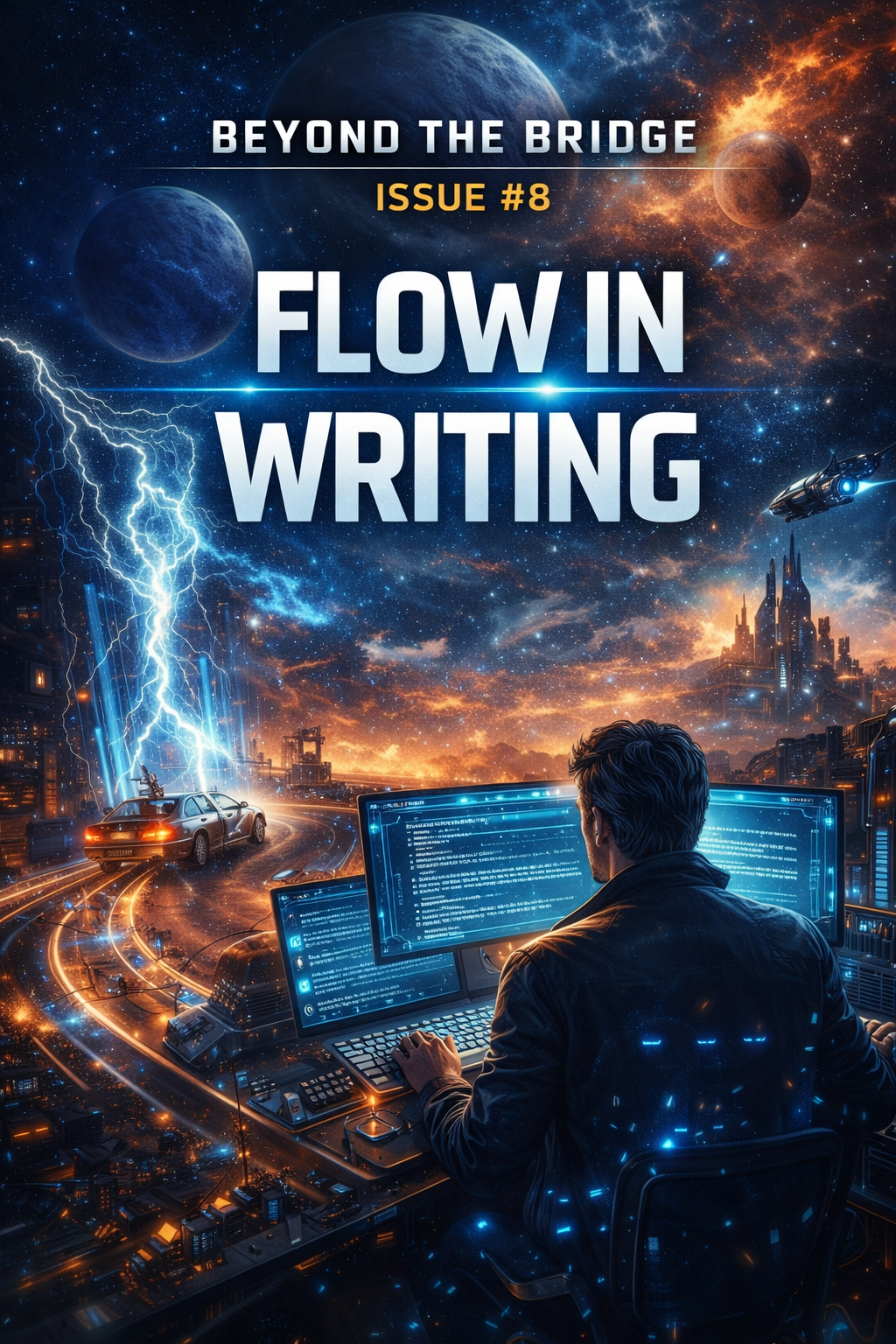
Finding Flow and Watching the Story Go
Every writer knows the feeling when the words suddenly start moving faster than your fingers.
You stop thinking about the next sentence because it is already there. The scene begins to unfold on its own. Characters start speaking before you even plan what they will say.
That is flow.
It does not happen every time you sit down to write. In fact, it rarely arrives when you try to force it. Flow tends to show up when the mind is fully inside the story and stops worrying about the mechanics of writing.
For me, it usually starts when I forget that I am writing at all, and I sink into just telling the story that needs to be told.
When the Story Starts Moving
Flow feels a little like stepping through a Bridge.
One moment you are on this side of the story, planning and outlining and adjusting sentences. The next moment you are inside the world itself. You are experiencing it, and building it from the inside. It’s like you are playing a video where you are in charge of every block and where it goes, but it’s natural as if you’re the conductor of an orchestra.
The strange thing about flow is that it often produces the most honest writing. When your brain stops micromanaging every word, the story has room to breathe.
Scenes become less calculated and more natural.
Many of the moments in Knocked that readers mention to me were written during those stretches where the story simply started moving on its own.
Getting Out of Your Own Way
The hardest part about flow is not entering it. The hardest part is allowing it.
Writers tend to interrupt themselves. We second guess sentences. We stop to fix grammar. We reread paragraphs that were written five minutes ago.
Every one of those habits pulls you out of flow.
Flow rewards momentum. It asks you to trust the direction of the scene and to let the words exist before you judge them.
Editing can come later. Flow belongs to the draft.
A few snippets that relate to this issue:
From the Chapter 4 – Seeing Myself for the First Time
We didn’t talk much after I restarted the movie (Back to the Future II), but I paused it at the point where Doc is sliding down the long extension cable and Marty is flying down the street toward the wire crossing from sidewalk-to-sidewalk.
“This is the best part,” I said leaning forward on the couch and pointing at the TV while looking at Denny, “this part changes everything.”
“OK, dude. Calm down. Three is still the best one in the trilogy,” he said arrogantly.
“Yeah, but without this part, there can be no three,” I said with comically wide eyes.
“OK… whatever. Can you hit play?” he said rolling his eyes.
I hit play.
I watched closely, attempting to slow the scene down in my mind so I could watch the exact moment the lightning struck the cable on the clock tower, sending electricity streaming down it. The electric pulse flowed to the wire crossing the street, just as Marty in the DeLorean rushed under. The lightning had charged the line as the special wire-hook attached to the top of the car/time machine made contact, precisely. This gave the time machine enough juice to power the flux capacitor (the device that made time travel possible). Marty, the DeLorean, the special hook, the flux capacitor, and all, are sent – Back to the Future!
This fictional movie gave me a glint of hope.
Your Turn To Cross
When was the last time you felt completely absorbed in something you were creating or reading?
That moment when time disappears and the work seems to move on its own.
Hit reply. I always enjoy hearing what puts people into that state.
Keep Reading on Substack
The Bridge doesn’t stop at your inbox. Step through to Substack for extended editions, author notes, and extra worlds.
This week, I continue with a longer discussion about writing POVs on my Substack.
Continue Exploring on Substack
Read my latest short story on derekcchance.substack.com
Take a moment and…
If you’ve read Knocked: Into Another Dimension and have a moment, an honest Amazon review, even a single sentence, helps the book survive in a very noisy multiverse. Reviews are how indie stories get discovered by new readers.
No pressure at all. Stars only is fine. One line is fine. Honest is all that matters.