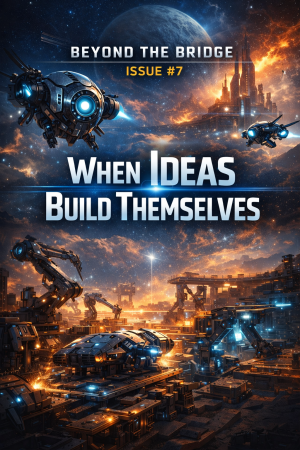
When Ideas Build Themselves In Writing
Some science fiction ideas hit you once and never leave.
One of those, for me, comes from the Bobiverse books by Dennis E. Taylor. The concept is simple on the surface: use automated factories to build more factories, which then build ships, probes, and infrastructure faster than any human workforce ever could.
Once you grasp it, you realize it changes everything.
As soon a system can reproduce itself, growth stops being linear. It becomes exponential. And suddenly, the story isn’t about, can we build this, but what happens after we do.
The Moment a Concept Clicks
Good sci-fi concepts feel less like inventions and more like discoveries. Autofactories are one of those ideas. They feel obvious in hindsight. Of course an advanced civilization wouldn’t hand-assemble everything. Of course it would design systems that remove humans from the bottleneck.
That idea reshaped how I think about handling scale in my own sci-fi story. Letting the autofactories operate, it took pressure off the main character to build things. It allowed for him to focus on more important things.
Concepts like autofactories, autonomous drones, and self-scaling systems stick with us because they feel close. We’re already surrounded by early versions of them. Algorithms optimizing algorithms. Systems learning without asking permission.
Sci-fi just takes the next logical step and asks us to live with it.
That’s why I love these ideas. They don’t shout. They whisper, this is where we’re headed.
How This Shows Up in Knocked
When I was writing Knocked, I found myself circling the same idea from a different angle. If you can travel between worlds, exploration alone isn’t enough. You need persistence. You need systems that can operate without you.
That’s where the drones came in.
They aren’t just tools. They are force multipliers. They scout, track, observe, and react faster than any human could. In a multiverse, where danger and opportunity scale rapidly, drones become the difference between surviving and falling behind.
Just like autofactories, they remove human limitation from the equation. That’s both powerful and unsettling.
A few snippets that relate to this issue:
From the Chapter 19 – She Dead
My three companions followed me into the mud room. We fanned out and inspected the whole place ourselves. I headed for the basement and Kel followed.
The resources I had ordered were already busy at work building more resources.
“This approach to building out more drones is amazing,” Kel said.
“Indeed. It’s way better than cranking them out by hand,” I said with a wink, “I didn’t invent the process though, I got the idea from the Bobiverse: auto-factories.”
Your Turn To Cross
What sci-fi concept still lives in your head long after you finished the book?
Not the plot. The idea.
The one that made you stop and think, oh… that changes everything.
Hit reply. I’m always collecting these.
Keep Reading on Substack
The Bridge doesn’t stop at your inbox. Step through to Substack for extended editions, author notes, and extra worlds.
This week, I continue with a longer discussion about writing POVs on my Substack.
Continue Exploring on Substack
Read my latest short story on derekcchance.substack.com